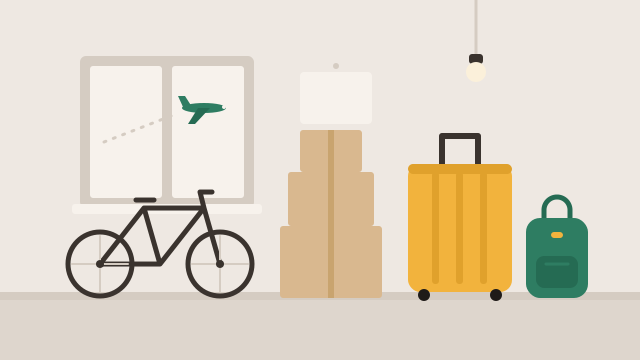
You've been given the Erasmus place or the internship abroad, and you start in the second semester. The excitement is huge, but there is a practical question that comes up before the flight: what do you do with everything you have in the room or flat where you live now?
Books, notes, a full year's worth of clothes, the desk, the bike, the little coffee maker… If you give up your rental while you're away, all of that has to go somewhere. Here is an orderly way to decide.
First, work out the dates
At many universities, the second-semester exchange runs from February to June. For example, the University of Zaragoza sets that period in its Erasmus+ master's call for the 2025-2026 academic year. Check the calendar of your host university, as each one has its own.
With that date in hand, count backwards:
- Your rental's notice period. Check your contract for how much notice you must give if you leave, and how to give it. If you're unsure, ask your landlord in writing as early as possible.
- January exams. If you have exams just before you leave, you won't want to spend that week packing. Many students have almost everything tidied away before the Christmas holidays and keep only what is essential.
- Coming back. If you return in June or July and go back to the same city in September, think also about where you'll be living then. Sometimes it's worth storing things until you have the new flat.
Take them to your family's home or store them in a storage unit?
There is no single answer. It depends on three things.
Distance. If your family lives nearby and has space, taking everything home is usually the simplest option. If they live hundreds of kilometres away, think about the journey out in January and the journey back in September. That's two removals instead of one.
What you'll use again here. There's no point carrying the desk, the chair, the bookshelf or the mattress far away only to bring them back a few months later. For those things, a storage unit in the city where you study may be more practical.
What each option costs. Compare what you would pay for transport, there and back, with what a small storage unit costs for the months you'll be away. On the portal you can see prices for each area, for example storage units in Madrid.
One option that works well: take your clothes and personal items home, and leave the furniture and bulky things you'll need when you return in a storage unit. If you share a flat and your flatmate is also leaving, sharing a storage unit may work out better value. That said, agree first who holds the contract and how you split the payment.
What size storage unit is usually enough
What a student accumulates fits into less space than you might think. As a guide:
- Closet (up to 1.5 m²). For boxes of books and notes, suitcases, seasonal clothing and a bike. This is typical if you lived in a room in a shared flat and don't have furniture of your own.
- Walk-in closet (from 1.5 to 2.5 m²). If you also have some furniture: a desk, a chair, a small bookshelf, a chest of drawers.
- Room (from 2.5 to 3.5 m²). If the mattress, the bed and the rest of the furniture in your room are yours.
Before booking, make a list of what you're going to store and stack the boxes in a corner. That way you can see quickly how much space they take up.
How to get your things ready for five or six months
They'll spend the spring in storage, so it's worth preparing them properly:
- No food, not even tins or sealed packets. It attracts pests and isn't worth the risk.
- Everything clean and dry. Wash clothes before storing them and let textiles dry completely. Damp is what does the most damage to things over a few months.
- Sturdy boxes of the same size, which stack better. Heavy items, such as books, go in small boxes. Light things go in the large ones.
- Vacuum bags for clothes and bedding. They take up much less space.
- Electronics in their original box or well wrapped, and with the batteries removed.
- The bike, clean and with the tyres slightly inflated. If you can, hang it up or lean it so the tyres don't bear all the weight for months.
- Label every box with what it contains and take photos of the contents. From abroad you'll be glad to know where everything is if someone has to look for something for you.
Put at the front what you'll need first when you return: sheets, some clothes and the basics for the kitchen.
Before you leave: contract, payments and access
A storage unit you'll use while you're away raises its own questions. Ask before you sign:
- Minimum term and notice. Some contracts are monthly and others require a minimum period. Check how much notice you must give to clear it when you get back.
- How it's paid. The most convenient option is a direct debit or card payment, so you don't have to do anything from abroad.
- Who can enter. If you want your family or a friend to be able to collect something while you're away, check whether you can authorise another person and how to do it.
- Opening hours and access on your return. If you arrive on a Sunday night on your return flight, it's good to know when you'll be able to collect your things.
- Insurance. Ask what the storage unit insurance covers, whether it is included, and whether your family's policy covers anything you're storing.
For example: Lucía studies in Madrid and goes to Lisbon from February to June. She leaves her room in a shared flat at the end of December. She takes her clothes to her parents' home and stores her boxes of books, her bike and a bookshelf she wants to use again in September in a Closet-sized unit at Armario de Trasteros Serrano. She pays by direct debit and authorises her brother to enter if necessary.
In short
Check the dates of your destination and your rental's notice period. Decide what goes home and what stays in the city. Choose the smallest size that works for you and prepare your things well for a few months. Once that's settled, all that's left is to think about the journey. </body> <alt>A suitcase and a backpack packed next to stacked cardboard boxes and a bicycle in an almost empty room, with an aeroplane in the sky beyond the window.</alt>