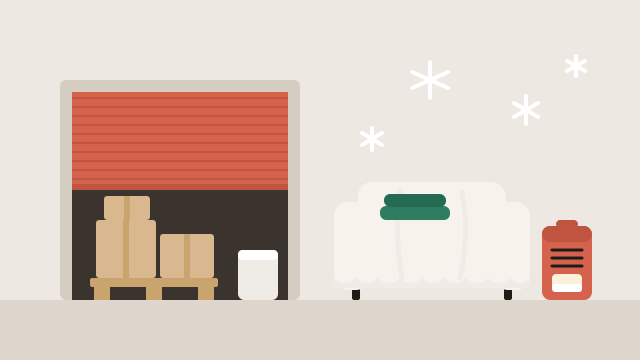
With the rain and the cold, many things we keep in a storage unit start to suffer: a mattress that picks up a smell, cardboard boxes that go soft, a wooden table that warps. There is almost always a solution if you plan ahead.
Here is the essentials so that your things get through the winter stored away and come out in spring just as they went in.
Why damp is the great enemy
Relative humidity is the amount of water vapour in the air. When it rises a lot or changes suddenly, materials feel it.
A manual from the Plan Nacional de Conservación Preventiva del Ministerio de Cultura (the National Preventive Conservation Plan of the Spanish Ministry of Culture), aimed at museums and monuments, gives benchmarks that also apply at home:
- Wood, textiles or paper can warp or break below 40% and above 70% relative humidity.
- The risk of pests and mould in organic materials increases from 60–70%.
- Metals can rust from 30%, and more so if it is warm.
The same manual stresses that sudden changes are just as harmful as extreme values: wood expands and contracts, and over time it cracks. That is why what you are looking for is not a perfect storage unit, but an environment that is as stable as possible.
In winter there is another problem: condensation. When warm, damp air touches a cold surface (an outside wall, the floor, a plastic cover), the water settles in tiny droplets. If that happens next to your boxes, the cardboard soaks it up.
What suffers most
Not everything needs the same care. Pay particular attention to:
- Mattresses, sofas and textiles: they absorb humidity and quickly smell stale.
- Wooden furniture, especially if it is solid or antique.
- Paper, books, photos and documents: they curl, stain and attract insects.
- Electronics and appliances: damp affects contacts and circuits.
- Tools, bikes and metal parts: they rust.
- Leather: shoes, bags or jackets can grow mould.
Plastic boxes, crockery and kitchenware hold up much better, although it is still wise to store them clean and dry.
Before storing: clean and thoroughly dry
This is the most important step and the one most often skipped. What goes into the storage unit damp stays damp.
- Wash and dry completely clothes, blankets and covers. Nothing should be "nearly dry".
- Clean the furniture and let it air for a day before wrapping it.
- Empty the appliances: fridge, washing machine or dishwasher, with no traces of water and the door left ajar.
- Dry and lightly oil tools and the metal parts of the bike.
- Remove the batteries from devices that allow it, so they do not corrode.
How to pack
- Plastic boxes with lids for clothes, papers and anything delicate. Cardboard is fine for things that hold up well, but it absorbs humidity and warps.
- Breathable covers (fabric or ones made specifically for mattresses and sofas) are better than sealed plastic. A plastic wrap around something large and cold can trap condensation inside.
- Absorbent sachets of silica gel or similar inside the boxes with papers, photos, electronics or leather.
- Paper or blankets between pieces of furniture so they do not rub, without squeezing them.
If an object already has mould spots, do not store it with the rest: clean it first or leave it outside, because mould spreads.
How to arrange it inside the storage unit
How you arrange things matters almost as much as the packing:
- Nothing directly on the floor. Use pallets, boards or shelving so air can circulate underneath and to protect against a possible water leak.
- Keep everything a few centimetres away from the walls, especially if any of them faces outside.
- Leave a gap for ventilation and so you can reach the things at the back without moving everything.
- Delicate items up high and in the middle: papers, electronics and textiles away from the floor and corners.
- Mattresses and sofas upright or on their side, in their covers and with nothing on top.
For this reason, it is best not to cut space too fine. If everything fits but without a single free gap, consider the next size up: for example, a Room (2.5–3.5 m²) instead of a Walk-in closet for bedroom furniture, or a Studio (3.5–5 m²) if you are storing the furniture from a flat during building work.
What to look at when choosing a storage unit for winter
If you are going to store delicate things, ask and check before renting:
- Whether it is inside or faces the street. Storage units inside a building usually have gentler temperature changes than those that face directly outside.
- Whether the premises have ventilation, and whether there is any measure against damp.
- Whether there are stains, a stale smell or water marks on walls, ceiling or floor. These are the best clue.
- Whether the access hours let you drop by when you need to.
- What the insurance covers, if there is any, and whether it includes water damage.
Imagine you are comparing two options in Madrid: Trasteros Serrano, in a basement without ventilation and with a stain in the corner, and Trasteros Box, on an inside floor, dry and ventilated. Even if the first costs a little less, for storing a sofa and boxes of books all winter the second will save you trouble.
You can compare the conditions of each place in the portal's storage units in Madrid.
Pop in from time to time
A storage unit is not a place to forget about your things, especially in winter.
- One visit a month is usually enough to spot problems in time.
- Open up and air it for a while when you are there, if the premises allow it.
- Check the absorbent sachets and replace them when they are saturated.
- Smell and look: the smell of damp gives warning before the stains do.
- After heavy rain, check that no water has got in.
If you detect damp, act quickly: take out what is affected, dry it thoroughly and let whoever manages the storage unit know.
With a little preparation at the start and the occasional visit, your things will get through the winter without problems.